
Bryan County Arrest Records and Court Charges
A Bryan County arrest record is the account of an arrest itself. It names the person booked, the arresting agency, the date and time, and the offense the officer listed at the scene. The Bryan County Sheriff's Office and city police make these records. An arrest is only an allegation, though. The charge record begins later, when the District Attorney reviews the case and decides what to file with the Court Clerk. Tim Webster serves as the Bryan County District Attorney, and his office is the charging authority for state crimes in District Court. The charges he files, not the officer's booking notes, are what control the court case.
These two records live in different places. The arrest and booking side sits with the sheriff and the jail, where the roster shows who is in custody, the booking date, and the listed charges. That detail is covered on the Bryan County inmate records page. The court charges after arrest sit in the District Court case file, searchable online by name or case number. The arrest charge and the filed charge are not always the same. An officer may book someone on one offense, and the prosecutor may then file a different one, drop it, or add more. The full case file, pleas, and final outcome appear in the Bryan County criminal court records.
Find Bryan County Arrest Records and Charges
Filed charges in Bryan County are searched through the same court portals that hold any District Court case. The county's official path is On Demand Court Records, known as ODCR, which the Court Clerk links as its public search tool. The Oklahoma State Courts Network, or OSCN, gives a second route to many dockets. Both let a user pull up a criminal case and read the charges the prosecutor filed. Booking detail does not appear there. For the jail roster and the arrest charges an officer listed, the sheriff's inmate search is the right tool.
- Open ODCR and set the court to Bryan under the Oklahoma District Courts group.
- Search by the defendant name in Last, First format or by the full case number.
- Open the case and read the Offense or Cause list, which holds each filed charge.
- Check each charge for its statute code, its level, and its current status.
The case identifier reveals the charge type at a glance. A felony reads as CF, a misdemeanor reads as CM, and an early filing may read as Criminal Probable Cause. Older files or papers not yet online can be requested from the Court Clerk at 402 W Evergreen in Durant or by phone at 580-924-1446.
How Bryan County Files Charges After Arrest
The charge record starts with a charging document. After booking, the District Attorney reviews the police reports and decides whether to file, and on what. The document the prosecutor files is what formally accuses the person and opens the court case. Oklahoma uses three main forms, and the one chosen depends on the offense and how the case reached the court.
| Complaint | Information | Indictment | |
|---|---|---|---|
| Filed By | Officer or prosecutor | Prosecutor | Grand jury |
| Common For | Misdemeanors | Many felonies | Serious felonies |
| Starts | The case | The case | The case |
An Information is the prosecutor's own charging document, and it carries most felony and misdemeanor filings in Bryan County. An Indictment comes from a grand jury, the citizen panel that reviews evidence for serious felonies. A complaint or probable cause filing often opens the matter at the first appearance. In ODCR these show as case types such as Criminal Felony, Criminal Misdemeanor, and Criminal Probable Cause.
Bryan County Sheriff Arrest Records
Not every arrest detail shows up in the court file. For the arrest report, the incident narrative, or booking paperwork, the Bryan County Sheriff's Office runs a Records Division with an online form. The sheriff's records request page lets the public ask for arrest and incident records under the Oklahoma Open Records Act.
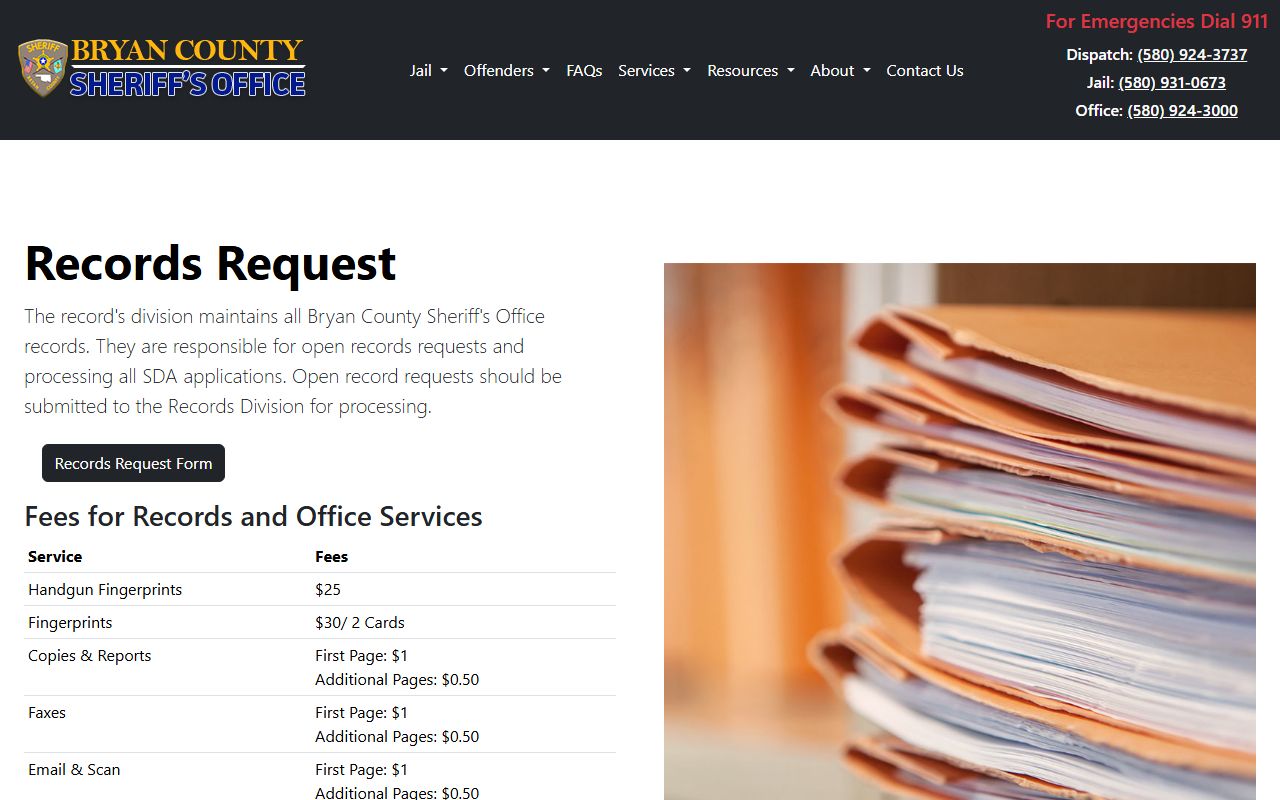
The form asks the requester to describe the records and the time frame, and it warns against sending money until staff calculate the exact fee. Copies run one dollar for the first page and fifty cents for each added page. Case numbers, which the form says are necessary, can be obtained through the Communication Center at 580-924-3737, option 4. Staff note a turnaround of about 24 hours, and the form sorts requesters into media, general public, and involved party.
Tips about a crime or a wanted person follow a different path. The sheriff's crime-tip form takes anonymous information that can lead to an arrest and, later, to filed court charges.
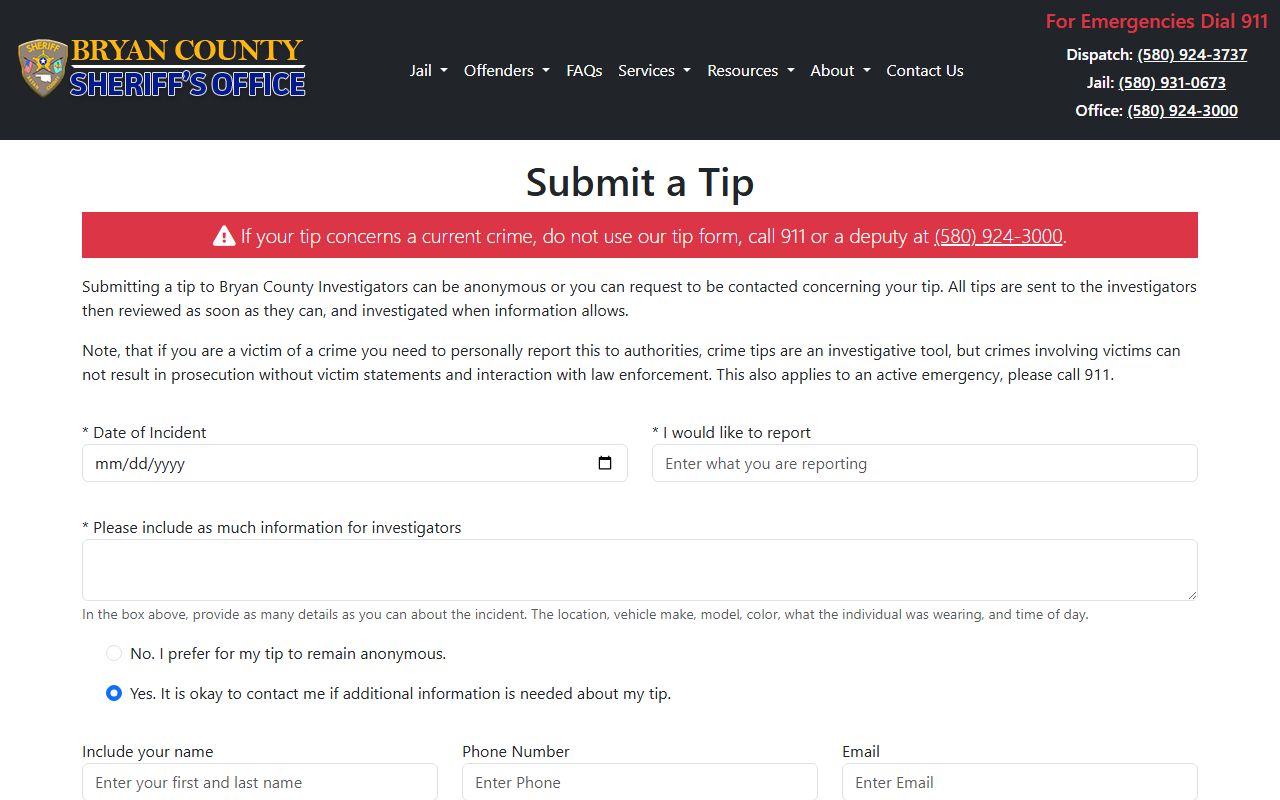
That form is for reporting information, not for clearing your own case or resolving a charge already in court. Anyone trying to settle a personal matter should call the Court Clerk or the Sheriff's Office at 580-924-3000 instead.
Bryan County Charge Status Explained
Charges rarely stay frozen. As a case moves, the prosecutor may amend a charge, reduce it, drop it, add a new one, or the court may dismiss it. The status shown in ODCR reflects where each charge stands on the day you look. Reading it correctly keeps a casual search from drawing the wrong conclusion about someone.
| Status | What It Means |
|---|---|
| Pending | The charge is filed and the case is still open with no final result. |
| Amended | The prosecutor changed the charge, often to fit new facts or evidence. |
| Reduced | The charge was lowered to a lesser offense, such as a felony cut to a misdemeanor. |
| Dropped | The prosecutor withdrew the charge before it reached a verdict. |
| Dismissed | The court ended the charge, and it closes without a conviction. |
| Nolle Prosequi | A Latin term meaning the State chose not to pursue the charge further. |
A single arrest can carry several charges at once, and each can hold a different status. One charge may stay pending while another is dismissed. Status can also turn on attendance: a defendant who misses a scheduled court date can draw a bench warrant, which shows in ODCR as a docket entry such as a failure to appear or failure to pay. The case file in the criminal court record ties the charges together and shows the plea or verdict for each.
Charges vs. Convictions in Bryan County
Being charged is not the same as being convicted. A charge is an accusation the prosecutor must still prove. A conviction is the result after a plea or a trial. An arrest record and a filed charge can both exist for a person who is later cleared. Treat a charge as a claim, not a finding of guilt.
| Charge | Conviction | |
|---|---|---|
| Stage | Accusation | Verdict or plea |
| Burden of Proof | Probable cause | Beyond a reasonable doubt |
| Public Record | Yes | Yes |
Note: a dismissed or dropped charge still appears in the public court file unless it is later sealed through an Oklahoma expungement.
Sealed and Expunged Bryan County Records
Oklahoma lets some people remove eligible arrest and charge records from public view. Sealing hides a record while leaving it on file. Expungement goes further and treats the record as if it should not show in a public search. Both run through the District Court where the case sits, and neither is automatic.
| Sealed | Expunged | |
|---|---|---|
| Visibility | Hidden from public | Treated as never disclosed publicly |
| Law Enforcement | Limited access | Very limited access |
| Eligibility | Set by category under 22 O.S. §18 | Granted by court order under 22 O.S. §19 |
The Oklahoma State Bureau of Investigation handles the criminal-history side of an expungement. Its expungement guidance says the agency cannot pre-approve eligibility, that the State may object even when a person qualifies, and that court and arrest expungement usually take about one month after OSBI receives a certified order and the fee. A separate path under 22 O.S. §991c covers records tied to a completed deferred sentence. The Court Clerk and qualified counsel handle the actual filing.
Bryan County Charge Codes and Severity
Every filed charge points back to a statute. The Offense or Cause line in an ODCR case lists the charge text and the code that names the Oklahoma law it rests on. That code tells you the level of the offense and what the State must prove.
Oklahoma sorts crimes into felonies, misdemeanors, and lesser violations. A felony carries the heaviest penalties and the longest exposure to prison, and it files under the CF case type. A misdemeanor is less serious and files under CM. Minor offenses and many traffic matters sit below that line. One arrest can produce several separate charges, so a single case may list a felony alongside one or more misdemeanors. Each charge keeps its own code, level, and status through the life of the case.
Statewide Charge and Criminal History Lookups
A county search shows the Bryan County side of a record. For a statewide view, charges and their outcomes can roll into an Oklahoma criminal history kept by the Oklahoma State Bureau of Investigation. That search is request-based and reaches across counties, which helps when a person has cases in more than one place. It is the formal route for an employer or anyone needing a record beyond a single courthouse.
State prison status carries its own search. The Oklahoma Department of Corrections offers an offender lookup for people in state custody after a conviction.
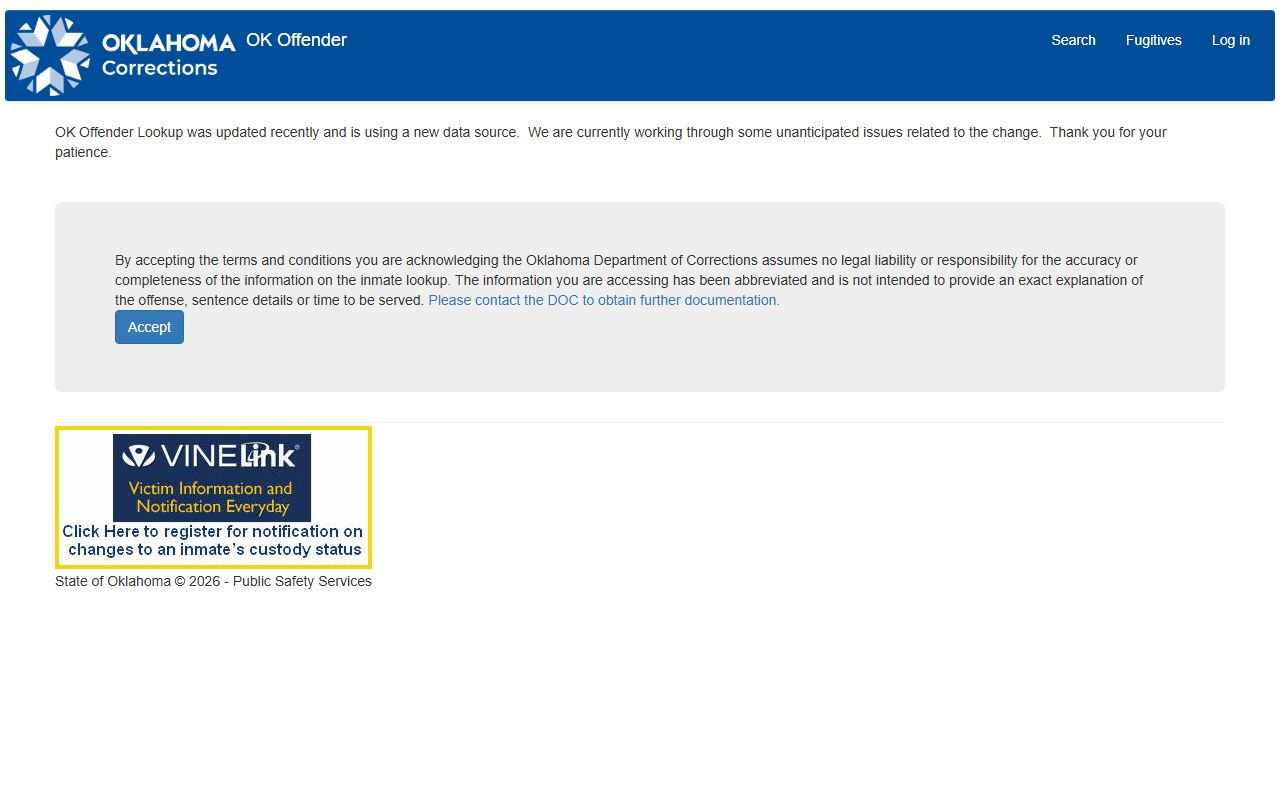
The agency warns the data is abbreviated and not an exact account of the offense, the sentence, or time to serve, so it should be confirmed against the court file. The DOC lookup tracks custody, not charges, and it is not a warrant or charge-clearance system.
Background Checks and Bryan County Arrest Records
A casual name search and a formal background check are not the same thing. A casual look at ODCR or the jail roster answers a quick question. A background check used for hiring, housing, or credit must follow the federal Fair Credit Reporting Act and use a regulated agency. Oklahoma arrest records and filed charges can appear in both, but the rules for using them differ sharply.
Important: This site is not a consumer reporting agency under the FCRA, and its results may not be used to decide employment, housing, credit, or insurance.
Restricted Charge Records in Bryan County
Not every arrest or charge is open to a public search. Oklahoma keeps juvenile court and related agency records confidential except where the law allows access, so a youthful-offender matter may not show full detail. Sealed and expunged cases drop out of the public view, even though the case once existed.
Law enforcement can also hold back parts of an active file. Under 51 O.S. §24A.8, agencies must release certain basic records but may protect investigatory material while a case is open. That is why an arrest can appear before the full incident report becomes available. A charge that is dismissed or never filed may still be withheld in some forms. When a record is restricted, the right step is to ask the Court Clerk or the sheriff's Records Division which part is public and which is not.